Article for infinite product with signature 20:(1,0,1,0,1,0,1,1,1,0,1,1,1,0,1,0,1,0,1,0)
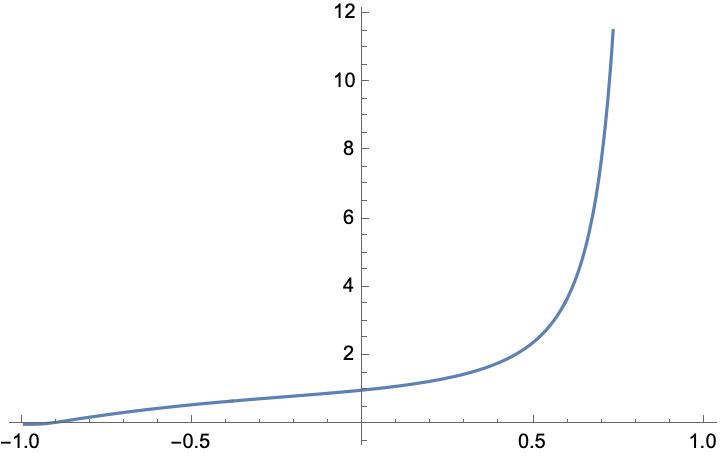
Combinatorial interpretation of product
\(r(n)\) is the number of partitions of \(n\) into parts congruent to \(\pm 1, \pm 3, \pm 5, \pm 7, \pm 8, \pm 9\pmod{20}\).
Asymptotic formula
\(\displaystyle r(n) \sim\frac{e^{\sqrt{\frac{2}{5}} \pi \sqrt{n}}}{2 \sqrt[4]{10} \sqrt{5+\sqrt{5}} n^{3/4}}\) as \(n\to\infty.\)
Power series expansion
First terms:
\(q\)-series representations
\(\displaystyle F(q) = \sum_{n=0}^\infty \frac{ q^{n(n+2)} }{ (q;q)_{2n+1} }\)
Bailey pair proof:
Insert Bailey Pair A(4) into the p-Bailey lemma, and apply the triple product identity followed by the quintuple product identity.
Combinatorial interpretations:
1st interpretation here
Notes:
Rogers [R94] (1894, p. 331, above (5))
Rogers [R17] (1917, p. 330 (3), 2nd equation)
Slater [S52] (96)
References
Abbate, J. (2001). Oral History: Interview with Lucy Slater. http://ethw.org/Oral-History:Lucy_Slater
Alder, H. L. (1948). The nonexistence of certain identities in the theory of partitions and compositions. Bull. Amer. Math. Soc., 54(8), 712–722. https://www.ams.org/journals/bull/1948-54-08/S0002-9904-1948-09062-0/S0002-9904-1948-09062-0.pdf
Alladi, K. (1998). On a partition theorem of Göllnitz and quartic transformations. J. Number Theory, 69, 153–180. https://doi.org/10.1006/jnth.1997.2215
Alladi, K., & Andrews, G. E. (2015). The dual of Göllnitz’s (big) partition theorem. Ramanujan J., 36, 171–201. https://doi.org/10.1007/s11139-014-9617-0
Alladi, K., Andrews, G. E., & Gordon, B. (1995). Refinements and generalizations of Capparelli’s conjecture on partitions. J. Algebra, 174, 636–658. https://doi.org/10.1006/jabr.1995.1144
Alladi, K., & Gordon, B. (1993). Generalizations of Schur’s partition theorem. Manuscripta Math., 79, 113–126. https://doi.org/10.1007/BF02568332
Alladi, K., & Gordon, B. (1995). Schur’s partition theorem, companions, refinements and generalizations. Trans. Amer. Math. Soc., 347(5), 1591–1608. https://doi.org/10.1090/S0002-9947-1995-1297520-X
Andrews, G. E. (1967). A generalization of the Göllnitz–Gordon partition theorems. Proc. Amer. Math. Soc., 8, 945–952. https://doi.org/10.1090/S0002-9939-1967-0219497-6
Andrews, G. E. (1968). On q-difference equations for certain well-poised basic hypergeometric series. Quart. J. Math., 19, 433–447. https://doi.org/10.1093/qmath/19.1.433
Andrews, G. E. (1970). A polynomial identity which implies the Rogers-Ramanujan identities. Scripta Math., 28, 297–305. https://www.scribd.com/doc/6625528/A-Polynomial-Identity-Which-Implies-the-Rogers-Ramanujan-Identities
Andrews, G. E. (1973). On the q-analog of Kummer’s theorem and applications. Duke Math. J., 40(3), 525–528. https://doi.org/10.1215/S0012-7094-73-04045-3
Andrews, G. E. (1974a). An analytic generalization of the Rogers–Ramanujan identities for odd moduli. Proc. Nat. Acad. Sci., 71(10), 4082–4085.
Andrews, G. E. (1974b). On the general Rogers–Ramanujan theorem. Memoirs Amer. Math. Soc., 152, 86 pp.
Andrews, G. E. (1975). On Rogers-Ramanujan type identities related to the modulus 11. Proc. London Math. Soc., 30, 330–346. https://doi.org/10.1112/plms/s3-30.3.330
Andrews, G. E. (1976). The Theory of Partitions (Vol. 2). Addison–Wesley.
Andrews, G. E. (1979). Partitions: Yesterday and Today. New Zealand Mathematical Society.
Andrews, G. E. (1981). Ramanujan’s “lost” notebook II: ϑ-function expansions. Adv. Math., 41, 173–185. https://doi.org/10.1016/0001-8708(81)90014-1
Andrews, G. E. (1982). L. J. Rogers and the Rogers–Ramanujan identities. Math. Chronicle, 11, 1–15.
Andrews, G. E. (1984). Multiple series Rogers–Ramanujan type identities. Pacific J. Math, 114, 267–283. https://doi.org/10.2140/pjm.1984.114.267
Andrews, G. E. (1985). Combinatorics and Ramanujan’s “lost” notebook. Surveys in Combinatorics, 103, 1–23.
Andrews, G. E. (1986a). q-Series: Their Development and Application in Analysis, Number Theory, Combinatorics, Physics, and Computer Algebra (Vol. 66). American Mathematical Society. https://bookstore.ams.org/cbms-66
Andrews, G. E. (1986b). The fifth and seventh order mock theta functions. Trans. Amer. Math. Soc., 293, 113–134. https://doi.org/10.1090/S0002-9947-1986-0814916-2
Andrews, G. E. (1989). Physics, Ramanujan, and computer algebra. In D. V. Chudnovsky & R. D. Jenks (Eds.), Computer Algebra. Marcel Dekker, Inc.
Andrews, G. E. (1990a). Euler’s `exemplum memorabile inductionis fallis’ and q-trinomial coefficients. J. Amer. Math. Soc., 3, 653–669. https://doi.org/10.2307/1990932
Andrews, G. E. (1990b). q-trinomial coefficients and the Rogers–Ramanujan identities. In B. C. B. et al. (Ed.), Analytic Number Theory (pp. 1–11). Birkhauser.
Andrews, G. E. (1994). Schur’s theorem, Capparelli’s conjecture and q-trinomial coefficients. In G. E. Andrews, D. M. Bressoud, & L. A. Parson (Eds.), The Rademacher Legacy to Mathematics. American Mathematical Society.
Andrews, G. E. (2001a). Bailey’s transform, lemma, chains and tree. In J. B. et al. (Ed.), Special Functions 2000 (pp. 1–22). Kluwer.
Andrews, G. E. (2001b). Some debts I owe. In D. Foata & G.-N. Han (Eds.), The Andrews Festschrift: Seventeen Papers on Classical Number Theory and Combinatorics (pp. 1–16). Springer.
Andrews, G. E. (2009). The finite Heine transformation. Integers, 9 (S), Article 1, 6 pp.
Andrews, G. E. (2013a). The discovery of Ramanujan’s lost notebook. In B. C. Berndt & D. Prasad (Eds.), The Legacy of Srinivasa Ramanujan (Vol. 20, pp. 77–88). Ramanujan Mathematical Society, India.
Andrews, G. E. (2013b). The Selected Works of George E. Andrews (with Commentary). (A. V. Sills, ed.), Imperial College Press, London.
Andrews, G. E. (2014). Knots and q-series. In K. Alladi, F. G. Garvan, & A. J. Yee (Eds.), Ramanujan 125 (Vol. 627, pp. 17–24). American Mathematical Society.
Andrews, G. E., Askey, R., & Roy, R. (1999). Special Functions (Vol. 71). Cambridge University Press. https://doi.org/10.1017/CBO9781107325937
Andrews, G. E., & Baxter, R. J. (1987). Lattice gas generalization of the hard hexagon model III: q-trinomial coefficients. J. Stat. Phys., 47, 297–330. https://doi.org/10.1007/BF01007513
Andrews, G. E., & Baxter, R. J. (1989). A Motivated proof of the Rogers–Ramanujan identities. Amer. Math. Monthly, 96, 401–409. https://doi.org/10.1080/00029890.1989.11972207
Andrews, G. E., & Baxter, R. J. (1990). SCRATCHPAD explorations for elliptic theta functions. In D. V. Chudnovsky & R. D. Jenks (Eds.), Computers in Mathematics (Vol. 125, pp. 17–33). Marcel Dekker.
Andrews, G. E., Baxter, R. J., & Forrester, P. J. (1984). Eight-vertex SOS model and generalized Rogers–Ramanujan type identities. J. Stat. Phys., 35, 193–266. https://doi.org/10.1007/BF01014383
Andrews, G. E., & Berkovich, A. (2002). The WP-Bailey tree and its implications. J. London Math. Soc. (2), 66, 529–549. https://doi.org/10.1112/S0024610702003617
Andrews, G. E., & Berndt, B. C. (2005). Ramanujan’s Lost Notebook, Part I. Springer. https://doi.org/10.1007/0-387-28124-X
Andrews, G. E., & Berndt, B. C. (2009). Ramanujan’s Lost Notebook, Part II. Springer. https://doi.org/10.1007/b13290
Andrews, G. E., Bringmann, K., & Mahlburg, K. (2015). Double series representations for Schur’s partition function and related identities. J. Combin. Theory Ser. A, 132, 102–119. https://doi.org/10.1016/j.jcta.2014.12.004
Andrews, G. E., & Eriksson, K. (2004). Integer partitions. Cambridge University Press. https://doi.org/10.1017/CBO9781139167239
Andrews, G. E., Knofpmacher, A., & Paule, P. (2000). An infinite family of Engel expansions of Rogers–Ramanujan type. Adv. Appl. Math., 25, 2–11. https://doi.org/10.1006/aama.2000.0686
Andrews, G. E., & Santos, J. P. O. (1997). Rogers–Ramanujan type identities for partitions with attached odd parts. Ramanujan J., 1, 91–99. https://doi.org/10.1023/A:1009719322309
Apostol, T. M. (1948). A Study of Dedekind Sums and their Generalizations [Phdthesis]. University of California at Berkeley.
Apostol, T. M. (1976). Introduction to Analytic Number Theory. Springer. https://doi.org/10.1007/978-1-4757-5579-4
Apostol, T. M. (1997). Modular functions and Dirichlet series in number theory (2nd ed., Vol. 41). Springer. https://doi.org/10.1007/978-1-4612-0999-7
Askey, R. (2001). The work of George Andrews: a Madison perspective. The Andrews Festschrift: Seventeen Papers on Classical Number Theory and Combinatorics, 17–38. https://doi.org/10.1007/978-3-642-56513-7_2
Bailey, W. N. (1935). Generalized Hypergeometric Series. Cambridge. https://archive.org/details/bwb_P8-ABP-096
Bailey, W. N. (1941). A note on certain q-identiites. Quart. J. Math., 12, 173–175. https://doi.org/10.1093/qmath/os-12.1.173
Bailey, W. N. (1947). Some identities in combinatory analysis. Proc. London Math. Soc. (2), 49, 421–435. https://doi.org/10.1112/plms/s2-49.6.421
Bailey, W. N. (1948). Identities of the Rogers-Ramanujan type. Proc. London Math. Soc. (2), 50, 1–10. https://doi.org/10.1112/plms/s2-50.1.1
Bailey, W. N. (1951). On the simplification of some identities of the Rogers–Ramanujan type. Proc. London Math. Soc. (3), 1, 217–221. https://doi.org/10.1112/plms/s3-1.1.217
Batchelor, M. T., & Foerster, A. (2016). Yang–Baxter integrable models in experiments: from condensed matter to ultracold atoms. J. Physics A, 49(17), 22 pp. https://doi.org/10.1088/1751-8113/49/17/173001
Baxter, R. J. (1980). Hard hexagons: exact solution. J. Phys. A, 13, L61–L70. https://doi.org/10.1088/0305-4470/13/3/007
Baxter, R. J. (1981). Rogers–Ramanujan identities in the hard hexagon model. J. Stat. Phys., 26, 427–452. https://doi.org/10.1007/BF01011427
Baxter, R. J. (1982). Exactly solved models in statistical mechanics. Academic Press. https://physics.anu.edu.au/research/ftp/_files/Exactly.pdf
Baxter, R. J., & Pearce, P. A. (1983). Hard squares with diagonal entries. J. Phys. A, 16, 2239–2255.
Baxter, R. J., & Pearce, P. A. (1984). Deviations from the critical density in the generalized hard hexagon model. J. Phys. A, 17, 2095–2108. https://doi.org/10.1088/0305-4470/17/10/021
Berkovich, A., & McCoy, B. M. (1996). Continued fractions and fermionic representations for characters of M(p,p’) minimal models. Lett. Math. Phys., 37, 49–66. https://doi.org/10.1007/BF00400138
Berkovich, A., & McCoy, B. M. (1997). Generalizations of the Andrews–Bressoud identities for the N=1 superconformal model SM(2,4ν). Math. Comput. Modelling, 26, 37–49. https://doi.org/10.1016/S0895-7177(97)00198-2
Berkovich, A., & McCoy, B. M. (1998). Rogers–Ramanujan identities: a century of progress from mathematics to physics. Doc. Math., 163–172. https://doi.org/10.4171/DMS/1-3/17
Berkovich, A., McCoy, B. M., & Orrick, W. P. (1996). Polynomial identities, indices, and duality for the N=1 superconformal model SM(2,4ν). J. Stat. Phys., 83, 795–837. https://doi.org/10.1007/BF02179546
Berkovich, A., McCoy, B. M., & Schilling, A. (1998). Rogers–Schur–Ramanujan type identities for the M(p,p’) minimal models of conformal field theory. Comm. Math. Phys., 191, 211–223. https://doi.org/10.1007/s002200050271
Berndt, B. C., & Rankin, R. A. (1995). Ramanujan: Letters and Commentary (Vol. 9). American Mathematical Society. https://bookstore.ams.org/view?ProductCode=HMATH/9
Bos, M. K. (2003). Coding the principal character formula for affine Kac–Moody Lie algebras. Math. Comput., 72(244), 2001–2012. https://www.jstor.org/stable/4100033
Boulet, C., & Pak, I. (2006). A combinatorial proof of the Rogers–Ramanujan and Schur identities. J. Combin. Theory Series A, 113, 119–130. https://doi.org/10.1016/j.jcta.2005.09.007
Bowman, D., McLaughlin, J., & Sills, A. V. (2009). Some more identities of Rogers–Ramanujan type. Ramanujan J., 18, 307–325. https://doi.org/10.1007/s11139-007-9109-6
Bressoud, D. M. (1979). A generalization of the Rogers–Ramanujan identities for all moduli. J. Combin. Theory, Ser. A, 27, 64–68. https://doi.org/10.1016/0097-3165(79)90008-6
Bressoud, D. M. (1980a). A combinatorial proof of Schur’s 1926 partition theorem. Proc. Amer. Math. Soc., 1979(2), 338–340. https://doi.org/10.1090/S0002-9939-1980-0565367-X
Bressoud, D. M. (1980b). Analytic and combinatorial generalizations of the Rogers–Ramanujan identities. Mem. Amer. Math. Soc., 227, 54 pp. https://www.ams.org/books/memo/0227/
Bressoud, D. M. (1981). Some identities for terminating q-series. Math. Proc. Cambridge Philos. Soc., 81, 211–223. https://doi.org/10.1017/S0305004100058114
Bressoud, D. M., & Zeilberger, D. (1982). A short Rogers–Ramanujan bijection. Discrete Math., 38, 313–315. https://doi.org/10.1016/0012-365X(82)90298-9
Bruinier, J., & Ono, K. (2013). Algebraic formulas for the coefficients of half-integral weight harmonic weak Maas forms. Adv. Math., 246, 198–219. https://doi.org/10.1016/j.aim.2013.05.028
Capparelli, S. (1996). A construction of the level 3 modules for the affine algebra A₂(2) and a new combinatorial identity of the Rogers–Ramanujan type. Trans. Amer. Math. Soc., 348 (2), 481–501. https://doi.org/10.1090/S0002-9947-96-01535-8
Carlitz, L. (1959). Some formulas related to the Rogers–Ramanujan identities. Annali Di Matematica Pura et Applicata, 47(1), 243–251. https://doi.org/10.1007/BF02410899
Carter, R. (2005). Lie algebras of finite and affine type. Cambridge University Press. https://doi.org/10.1017/CBO9780511614910
Cayley, A. (1884). Note on a partition-series. Amer. J. Math., 6, 63–64. https://doi.org/10.2307/2369210
Chan, H. H., & Huang, S.-S. (1997). Ramanujan–Göllnitz–Gordon continued fraction. Ramanujan J., 1, 75–90. https://doi.org/10.1023/A:1009767205471
Choliy, Y., & Sills, A. V. (2016). A formula for the partition function that `counts’. Ann. Combin., 20, 301–316. https://doi.org/10.1007/s00026-016-0305-1
Cigler, J. (2004). q-Fibonacci polynomials and the Rogers–Ramanujan identities. Ann. Combin., 8, 269–285. https://doi.org/10.1007/s00026-004-0220-8
Cooper, S. (2006). The quintuple product identity. Int. J. Number Theory, 2(1), 115–161. https://doi.org/10.1142/S1793042106000401
Corteel, S., & Lovejoy, J. (2004). Overpartitions. Trans. Amer. Math. Soc., 356, 1623–1635. https://doi.org/10.1090/S0002-9947-03-03328-2
Corteel, S., & Lovejoy, J. (2009). Overpartitions and the q-Bailey identity. Proc. Edinburgh Math. Soc., 52, 297–306. https://doi.org/10.1017/S0013091507000314
Corteel, S., Savage, C., & Sills, A. V. (2012). Lecture hall sequences, q-series, and asymmetric partition identities. In Partitions, q-series, and Modular Forms (Vol. 23). Springer. https://doi.org/10.1007/978-1-4614-0028-8_6
Daum, J. A. (1942). The basic analogue of Kummer’s theorem. Bull. Amer. Math. Soc., 48, 711–713. https://doi.org/10.1090/s0002-9904-1942-07764-0
de la Vallé-Poussin, C. (1896). Recherches analytiques sur la théorie des nombres premiers. Ann. Soc. Sci. Bruxelles, 20, 183–256, 281–297.
Diamond, F., & Shurman, J. (2005). A First Course in Modular Forms (Vol. 228). Springer–Verlag. https://doi.org/10.1007/978-0-387-27226-9
Duke, W. (2014). Almost a century of answering the question: What is a mock theta function? Notices Amer. Math. Soc., 61, 1314–1320.
Dyson, F. J. (1943). Three identities in combinatory analysis. J. London Math. Soc., 18, 35–39. https://doi.org/10.1112/jlms/s1-18.1.35
Dyson, F. J. (1988). A walk through Ramanujan’s garden. In G. E. A. et al. (Ed.), Ramanujan Revisited: Proceedings of the Centenary Conference, University of Illinois at Urbana–Champaign, June 1–5, 1987 (pp. 7–28). Academic Press.
Ekhad, S. B., & Tre, S. (1990). A purely verification proof of the first Rogers–Ramanujan identity. J. Comb. Theory, Ser. A, 54, 309–311. https://doi.org/10.1016/0097-3165(90)90038-X
Engel, F. (1913). Entwicklung der Zahlen nach Stammbruechen. Verhandlungen Der 52. Versammlung Deutscher Philogen Und Schulmaenner in Marburg, 190–191.
Euler, L. (1988). Introduction to analysis of the infinite (translation of Introductio in anlysin infinitorum, 1748) (Vol. 1). Springer Verlag. https://doi.org/10.1007/978-1-4612-1021-4
Folsom, A., Ono, K., & Rhoades, R. C. (2013). Mock theta functions and quantum modular forms. Forum of Mathematics, Pi, 1, 27 pp. https://doi.org/10.1017/fmp.2013.3
Forrester, P. J., & Baxter, R. J. (1985). Further exact solutions of the eight vertex SOS model and generalized Rogers–Ramanujan type identities. J. Stat. Phys., 38, 435–472. https://doi.org/10.1007/BF01010471
Fricke, R. (1916). Die Elliptischen Funktionen und ihre Anwendungen. Ersete Teil, Teubner.
Garoufalidis, S., & Le, T. T. Q. (2015). Nahm sums, stability and the colored Jones polynomial. Research Math. Sci., 2, 1–55. https://doi.org/10.1186/2197-9847-2-1
Garrett, K. C., Ismail, M. E. H., & Stanton, D. (1999). Variants of the Rogers–Ramanujan identities. Adv. Appl. Math., 23, 274–299. https://doi.org/10.1006/aama.1999.0658
Garsia, A. M., & Milne, S. C. (1981a). A method for constructing bijections for classical partition identities. Proc. Nat. Acad. Sci. USA, 78, 2026–2028. https://doi.org/10.1073/pnas.78.4.2026
Garsia, A. M., & Milne, S. C. (1981b). A Rogers–Ramanujan bijection. J. Combin. Theory Series A, 31, 289–339. https://doi.org/10.1016/0097-3165(81)90062-5
Gauss, C. F. (1813). Disquistiones generalies circa seriem infinitam. Comm. Soc. Reg. Sci. Gött. Rec., 2.
Gessel, I., & Stanton, D. (1983). Applications of q-Lagrange inversion to basic hypergeometric series. Trans. Amer. Math. Soc., 277, 173–201. https://doi.org/10.1090/S0002-9947-1983-0690047-7
Glaisher, J. W. L. (1883). A theorem in partitions. Messenger of Math., 12, 158–170.
Göllnitz, H. (1960). Einfache Partitionen [Mathesis]. Göttingen.
Göllnitz, H. (1967). Partitionen mit Differenzenbedingungen. J. Reine Angew. Math., 225, 154–190.
Gordon, B. (1961). A combinatorial generalization of the Rogers–Ramanujan identities. Amer. J. Math., 83(2), 393–399. https://doi.org/10.2307/2372962
Gordon, B. (1965). Some continued fractions of the Rogers–Ramanujan type. Duke Math. J., 31, 741–748. https://doi.org/10.1215/S0012-7094-65-03278-3
Gordon, B. (1983). Sieve-equivalence and explicit bijections. J. Combin. Theory Series A, 34, 90–92. https://doi.org/10.1016/0097-3165(83)90043-2
Griffin, M., Ono, K., & Warnaar, S. O. (2016). A framework of Rogers–Ramanujan identities and their arithmetic properties. Duke Math. J., 165, 1475–1527.
Gu, N. S. S., & Prodinger, H. (2010). One-parameter generalizations of Rogers–Ramanujan type identiites. Adv. Appl. Math., 45, 149–196. https://doi.org/10.1016/j.aam.2010.01.002
Hadamard, J. (1896). Sur la distribution des zéros de la fonction ζ(s) et ses conséquences arithmétiques. Bull. Soc. Math. France, 24, 199–220. https://www.numdam.org/item/10.24033/bsmf.545.pdf
Hagis, P. (1963). Partitions into odd summands. Amer. J. Math., 85, 213–222. https://doi.org/10.2307/2373210
Hall, N. (1936). An algebraic identity. J. London Math. Soc., 11, 276. https://doi.org/10.1112/jlms/s1-11.4.276
Hardy, G. H. (1937a). Lectures by Godfrey H. Hardy on the Mathematical work of Ramanujan. Edwards Brothers.
Hardy, G. H. (1937b). The Indian mathematician Ramanujan. Amer. Math. Monthly, 44(3), 137–155. https://doi.org/10.1080/00029890.1937.11987940
Hardy, G. H. (1940). Ramanujan: Twelve Lectures Suggested by His Life and Work. Cambridge University Press.
Hardy, G. H., & Ramanujan, S. (1918). Asymptotic formulæ in combinatory analysis. Proc. London Math. Soc., 17, 75–115. https://doi.org/10.1112/plms/s2-17.1.75
Heine, E. (1878). Handbuch der Kugelfunctionen, Theorie und Anwendungen (Vol. 1). Reimer.
Herschel, J. F. W. (1818). On circulating functions, and on the integration of a class of equations of finite differences into which they enter as coefficients. Philosophical Trans. Royal Soc., 108, 144–168. https://doi.org/10.1098/rstl.1818.0011
Hickerson, D. (1988). A proof of the mock theta conjectures. Invent. Math., 94, 639–660. https://doi.org//10.1007/BF01394279
Hirschhorn, M. D. (1979). Some partition theorems of Rogers--Ramanujan type. J. Combin. Theory Ser. A, 27, 33–37. https://doi.org//10.1016/0097-3165(79)90005-0
Hua, L.-K. (1942). On the number of partitions into unequal parts. Trans. Amer. Math. Soc., 51, 194–201. https://doi.org/10.2307/1989985
Iverson, K. E. (1962). A Programming Language. Wiley.
Jackson, F. H. (1928). Examples of a generalization of Euler’s transformation for power series. Mess. Math., 57, 169–187.
Jimbo, M., & Miwa, T. (1985). A solvable lattice model and related Rogers–Ramanujan type identities. Physica, 15D, 335–353. https://doi.org/10.1016/S0167-2789(85)80003-8
Kac, V. (1990). Infinite dimensional Lie algebras (3rd ed.). Cambridge University Press. https://doi.org/10.1007/978-1-4757-1382-4
Kanade, S., Lepowsky, J., Russell, M. C., & Sills, A. V. (2017). Ghost series and a motivated proof of the Andrews–Bressoud identities. J. Combin. Theory Ser. A, 146, 33–62. https://doi.org/10.1016/j.jcta.2016.07.004
Kanade, S., & Russell, M. C. (2015). IdentityFinder and some new identities of Rogers–Ramanujan type. Experimental Mathematics, 24(2), 419–423. https://doi.org/10.1080/10586458.2015.1015186
Kilford, L. J. P. (2008). Modular Forms: A Classical and Computational Introduction. Imperial College Press.
Knopfmacher, A., & Knopfmacher, J. (1988). Inverse polynomial expansions of Laurent series. In Constr. Approx. (Vol. 4, pp. 379–389). https://doi.org/10.1007/BF02075468
Knopp, M. I. (1993). Modular Functions in Analytic Number Theory (second). AMS Chelsea.
Knuth, D. E. (1992). Two notes on notation. Amer. Math. Monthly, 99(5), 403–422.
Koblitz, N. (1984). Introduction to Elliptic Curves and Modular Forms (Vol. 97). Springer–Verlag.
Lebesgue, V.-A. (1840). Sommation de quelques séries. Journal Math. Pures Appl., 5, 42–71. http://www.numdam.org/item/JMPA_1840_1_5__42_0.pdf
Lehmer, D. H. (1946). Two nonexistence theorems on partitions. Bull. Amer. Math. Soc., 52, 538–544.
Lehner, J. (1941). A partition function connected with the modulus 5. Duke Math. J., 8, 631–655. https://doi.org/10.1215/S0012-7094-41-00854-2
Lepowsky, J. (2007). Some developments in vertex operator algebra theory, old and new. In Y.-Z. Huang & K. C. Misra (Eds.), Lie Algebras, Vertex Operator Algebras and their Applications (pp. 355–388). American Mathematical Society.
Lepowsky, J., & Milne, S. (1978). Lie algebraic approaches to classical partition identities. Adv. Math., 29, 15–59. https://doi.org/10.1016/0001-8708(78)90004-X
Lepowsky, J., & Wilson, R. L. (1978). Construction of the affine Lie algebra A₁(1). Comm. Math. Phys., 62, 45–53. https://doi.org/10.1007/BF01940329
Lepowsky, J., & Wilson, R. L. (1981). A new family of algebras underlying the Rogers–Ramanujan identities. Proc. Nat. Acad. Sci. USA, 78, 7254–7258. https://doi.org/10.1073/pnas.78.12.7254
Lepowsky, J., & Wilson, R. L. (1982). A Lie theoretic interpretation and proof of the Rogers–Ramanujan identities. Adv. Math., 45, 21–72. https://doi.org/10.1016/S0001-8708(82)80012-1
Lepowsky, J., & Wilson, R. L. (1984). The structure of standard modules I: universal algebras and the Rogers–Ramanujan identities. Invent. Math., 77, 199–290. https://doi.org/10.1007/BF01388447
Lepowsky, J., & Wilson, R. L. (1985). The structure of standard modules II: the case A₁(1), principal gradation. Invent. Math., 79, 417–442. https://doi.org/10.1007/BF01388515
Lepowsky, J., & Zhu, M. (2012). A motivated proof of Gordon’s identities. Ramanujan J., 29, 199–211. https://doi.org/10.1007/s11139-012-9388-4
Loxton, J. H. (1984). Special values of the dilogarithm function. Acta Arith., 43, 155–166. https://doi.org/10.4064/aa-43-2-155-166
Lynch, J. (original airdate: October 28, 1997). The Proof. Nova, PBS television series.
Macdonald, I. G. (1999). Symmetric Functions and Hall Polynomials (2nd ed.). Oxford University Press. https://doi.org//10.1093/oso/9780198534891.001.0001
MacMahon, P. A. (1918). Combinatory Analysis: Vol. II. Cambridge University Press. https://archive.org/details/combinatoryanaly02macmuoft/page/n5/mode/2up
McLaughlin, J., & Sills, A. V. (2008). Ramanujan–Slater type identities related to the moduli 18 and 24. J. Math. Anal. Appl., 344, 765–777. https://doi.org/10.1016/j.jmaa.2008.03.033
McLaughlin, J., & Sills, A. V. (2009). Combinatorics of Ramanujan–Slater type identities. Integers, 9 (S), Article 10, 14 pp.
McLaughlin, J., & Sills, A. V. (2012). On a pair of identities from Ramanujan’s lost notebook. Ann. Comb., 16, 591–607. https://doi.org/10.1007/s00026-012-0148-3
McLaughlin, J., Sills, A. V., & Zimmer, P. (2008). Rogers–Ramanujan–Slater type identities. Electronic J. Comb., 15, Dynamic Survey #15, 59 pp.
McLaughlin, J., Sills, A. V., & Zimmer, P. (2009). Rogers–Ramanujan computer searches. J. Symbolic Computation, 44, 1068–1078. https://doi.org/10.1016/j.jsc.2009.02.003
Meinardus, G. (1954). Asymptotische Aussagen über Partitionen. Math. Z., 59, 388–398. https://doi.org/10.1007/BF01180268
Melzer, E. (1994). Fermionic character sums and the corner transfer matrix. Internat. J. Modern Phys. A, 9, 1115–1136. https://doi.org/10.1142/S0217751X94000510
Mohammed, M., & Zeilberger, D. (2005). Sharp upper bounds for the orders of the recurrences output by the Zeilberger and q-Zeilberger algorithms. J. Symbolic Comput., 39, 201–207. https://doi.org/10.1016/j.jsc.2004.10.002
Nandi, D. (2014). Partition identities arising from the standard A₂(2) modules of level 4 [Phdthesis]. Rutgers.
Niven, I. (1940). On a certain partition function. Amer. J. Math., 353–364. https://doi.org/10.2307/2371459
O’Hara, K. M. (1988). Bijections for partition identities. J. Combin. Theory Series A, 49, 13–25. https://doi.org/10.1016/0097-3165(88)90026-X
Ono, K. (2003). The Web of Modularity: Arithmetic of the Coefficients of Modular Forms and q-Series (Vol. 103). American Mathematical Society.
Pak, I. (2006). Partition bijections: a survey. Ramanujan J., 12, 5–75. https://doi.org/10.1007/s11139-006-9576-1
Paule, P. (1982). Zwei neue Transformationen als elementare Anwendungen der q-Vandermonde Formel [Phdthesis]. University of Vienna.
Paule, P. (1985). On identities of the Rogers–Ramanujan type. J. Math. Anal. Appl., 107, 255–284. https://doi.org/10.1016/0022-247X(85)90368-3
Paule, P. (1987). A note on Bailey’s lemma. J. Combin. Theory, Ser. A, 44, 164–167. https://doi.org/10.1016/0097-3165(87)90070-7
Paule, P. (1994). Short and easy computer proofs of the Rogers–Ramanujan identities and identities of similar type. Electronic J. Combin., 1, 9 pp.
Petkovšek, M., Wilf, H. S., & Zeilberger, D. (1996). A=B. A. K. Peters, Ltd.
Rademacher, H. A. (1937). On the partition function p(n). Proc. London Math. Soc. (2), 43, 241–254. https://doi.org/10.1112/plms/s2-43.4.241
Rademacher, H. A. (1943). On the expansion of the partition function in a series. Ann. Math., 44(3), 416–422. https://doi.org/10.2307/1968973
Rademacher, H. A. (1973). Topics in Analytic Number Theory. Springer. https://doi.org/10.1007/978-3-642-80615-5
Ramanujan, S. (1927). Collected Papers. (G. H. Hardy, P. V. Seshu Aiyar,.
Ramanujan, S. (1988). The Lost Notebook and Other Unpublished Papers. Narosa Publishing House.
Remmel, J. (1982). Bijective proofs of some classical partition identities. J. Combin. Theory Series A, 33, 273–286.
Rhoades, R. C. (2013). On Ramanujan’s defintion of mock theta function. Proc. Nat. Acad. Sci. USA, 110(19), 7592–7594.
Rogers, L. J. (1893a). Memoir on the expansion of some infinite products. Proc. London Math. Soc. (1), 24, 337–352. https://doi.org/10.1112/plms/s1-24.1.337
Rogers, L. J. (1893b). On a three-fold symmetry in the elements of Heine’s series. Proc. London Math. Soc., 24, 171–179.
Rogers, L. J. (1894). Second memoir on the expansion of certain infinite products. Proc. London Math. Soc. (1), 25, 318–343. https://doi.org/10.1112/plms/s1-25.1.318
Rogers, L. J. (1895). Third memoir on the expansion of certain infinite products. Proc. London Math. Soc. (1), 26, 15–32. https://doi.org/10.1112/plms/s1-26.1.15
Rogers, L. J. (1917). On two theorems of combinatory analysis and some allied identities. Proc. London Math. Soc., 16, 315–336.
Rogers, L. J., & Ramanujan, S. (1919). Proof of certain identities in combinatory analysis. C Ambr. Phil. Soc. Proc., 19, 211–216. https://doi.org/10.1112/plms/s2-16.1.315
Rota, G.-C. (2009). Indiscrete Thoughts. Birkhäuser.
Rothe, H. (1811). Systematisches Lehrbuch der Aritmetik.
Savage, C.D. and Sills, A. V. (2011). On an identity of Gessel and Stanton and the new little Göllnitz identities. Adv. Appl. Math, 46, 563–575. https://doi.org/10.1016/j.aam.2009.12.009
Schilling, A., & Warnaar, S. O. (1998). Supernomial coefficients, polynomial identities, and q-series. Ramanujan J., 2, 459–494.
Schur, I. (1917). Ein Beitrag zur additiven Zahlentheorie und zur Theorie der Kettenbrüche. S.–B. Preuss. Akad. Wiss. Phys. Math. Klasse, 302–321.
Schur, I. (1926). Zur additive Zahlentheorie. S.–B. Preuss. Akad. Wiss. Phys. Math. Klasse, 488–495.
Sears, D. B. (1951). On the transformation theory of basic hypergeometric functions. Proc. London Math. Soc. (2), 53, 158–180.
Sears, D. B. (1952). Two identities of Bailey. J. London Math. Soc., 27, 510–511.
Selberg, A. (1936). Über einige arithmetische Identitäten. Avrandlinger Norske Akad., 8, 23 pp.
Sills, A. V. (2003). Finite Rogers–Ramanujan type identities. Electronic J. Combin., #R13, 122 pp.
Sills, A. V. (2004a). q-difference equations and identities of the Rogers–Ramanujan-Bailey type. J. Difference Equ. Appl., 10, 1069–1084.
Sills, A. V. (2004b). RRtools—a Maple package for aiding the discovery and proof of finite Rogers–Ramanujan type identities. J. Symbolic Comput., 37, 415–448.
Sills, A. V. (2005). Identities of the Rogers–Ramanujan–Bailey type. J. Math. Anal. App., 308, 669–688.
Sills, A. V. (2006). On identities of the Rogers–Ramanujan type. Ramanujan J., 11, 403–429.
Sills, A. V. (2007). Identities of the Rogers–Ramanujan–Slater type. Int. J. Number Theory, 3, 293–323.
Slater, L. J. (1951a). A new proof of Rogers’s transformations of infinite series. Proc. London Math. Soc. (2), 53, 460–475.
Slater, L. J. (1951b). Functions of hypergeometric type [Phdthesis]. University of London, Bedford College.
Slater, L. J. (1952). Further identities of the Rogers-Ramanujan type. Proc. London Math. Soc. (2), 54, 147–167. https://doi.org/10.1112/plms/s2-54.2.147
Slater, L. J. (1954). A note on equivalent product theorems. Math. Gazette, 38, 127–128.
Slater, L. J. (1960). Confluent Hypergeometric Functions. Cambridge University Press.
Slater, L. J. (1962). Wilfrid Norman Bailey. J. London Math. Soc., 37, 504–512.
Slater, L. J. (1966). Generalized Hypergeometric Functions. Cambridge University Press.
Smoot, N. A. (2016). A partition function connected with the Göllnitz–Gordon identities. In M. C. Pereyra, S. Marcantongnini, A. M. Stokolos, & W. U. Romero (Eds.), Harmonic Analysis, Partial Differential Equations, Complex Analysis, Banach Spaces, and Operator Theory: Celebrating Cora Sadosky’s Life. Springer.
Stanton, D. (2001). The Bailey–Rogers–Ramanujan group. Q-Series with Applications in Combinatorics, Number Theory, and Physics, 291.
Starcher, G. W. (1931). On identities arising from solutions to q-difference equations and some interpretations in number theory. Amer. J. Math., 53, 801–816.
Stein, W. A. (2007). Modular Forms, a Computational Approach (Vol. 79). American Mathematical Society.
Stembridge, J. R. (1990). Hall–Littlewood functions, Plane partitions, and the Rogers–Ramanujan identities. Trans. Amer. Math. Soc., 319(2), 469–498.
Sylvester, J. J., & Franklin, F. (1882). A constructive theory of partitions, arranged in three acts, an interact, and an exodion. Amer. J. Math., 5(1), 251–330.
Tamba, M., & Xie, C. (1995). Level three standard modules for A₂(2). J. Pure Appl. Algebra, 105 (1), 53–92.
Tannery, J., & Molk, J. (1896). Eléments de la théorie des Fonctions Elliptiques. Gauthiers–Villars.
Todt, H. (2011). Asymptotics in partition functions [Phdthesis]. Pennsylvania State University.
Uspensky, J. V. (1920). Asymptotic formulæ for numerical functions which occur in the theory of partitions. Izv. Akad. Nauk SSSR, 14, 199–218.
Verma, A., & Jain, V. K. (1980). Transformations between basic hypergeometric series on different bases and identities of the Rogers–Ramanujan type. J. Math. Anal. Appl., 76, 230–269.
Verma, A., & Jain, V. K. (1982). Transformations of non-terminating basic hypergeometric series, their contour integrals and applications to Rogers–Ramanujan type identities. J. Math. Anal. Appl., 87, 9–44.
Wallis, J. (1655). Arithmetica Infinitorum.
Warnaar, S. O. (2001a). Refined q-trinomial coefficients and character identities. J. Stat. Phys., 102, 1065–1081.
Warnaar, S. O. (2001b). The generalized Borwein conjecture. Q-Series with Applications to Combinatorics, Number Theory, and Physics, 291, 243–267.
Warnaar, S. O. (2003). Partial theta functions I: Beyond the lost notebook. Proc. London Math. Soc., 87, 363–395.
Watson, G. N. (1929). A new proof of the Rogers–Ramanujan identities. J. London Math. Soc., 4, 4–9.
Watson, G. N. (1936). The final problem: an account of the mock theta functions. J. London Math. Soc. (1), 11, 55–80.
Watson, G. N. (1937). The mock theta functions (2). Proc. London Math Soc. (2), 42, 274–304.
Watson, G. N. (1944). A treatise on the theory of Bessel functions (2nd ed.). Cambridge University Press.
Whipple, F. J. W. (1926). On well-poised series, generalized hypergeometric series having parameters in pairs, each pair with the same sum. J. London Math. Soc., 24, 247–263.
Whittaker, E. T., & Watson, G. N. (1927). A Course of Modern Analysis (4th ed.). Cambridge.
Wilf, H. S., & Zeilberger, D. (1990). Rational functions certify combinatorial identities. J. Amer. Math. Soc., 3, 147–158.
Wilf, H. S., & Zeilberger, D. (1992). An algorithmic proof theory for hypergeometric (ordinary and “q”) multisum/integral identities. Invent. Math., 108, 575–633.
Zagier, D. (2010). Quantum modular forms. Clay Mathematics Proceedings, 11, 659–675.
Zeilberger, D. (1990). A fast algorithm for proving terminating hypergeometric identities. Discrete Math., 80, 207–211.
Zeilberger, D. (1991). The method of creative telescoping. J. Symbolic Comput., 11, 195–204.
Zuckerman, H. S. (1939). On the coefficients of certain modular forms belonging to subgroups of the modular group. Trans. Amer. Math. Soc., 45, 298–321.
Zwegers, S. (2002). Mock theta functions [Phdthesis]. Univ. Utrecht, the Netherlands.
Zwegers, S. (2009). On two fifth order mock theta functions. Ramanujan J., 20, 207–214.